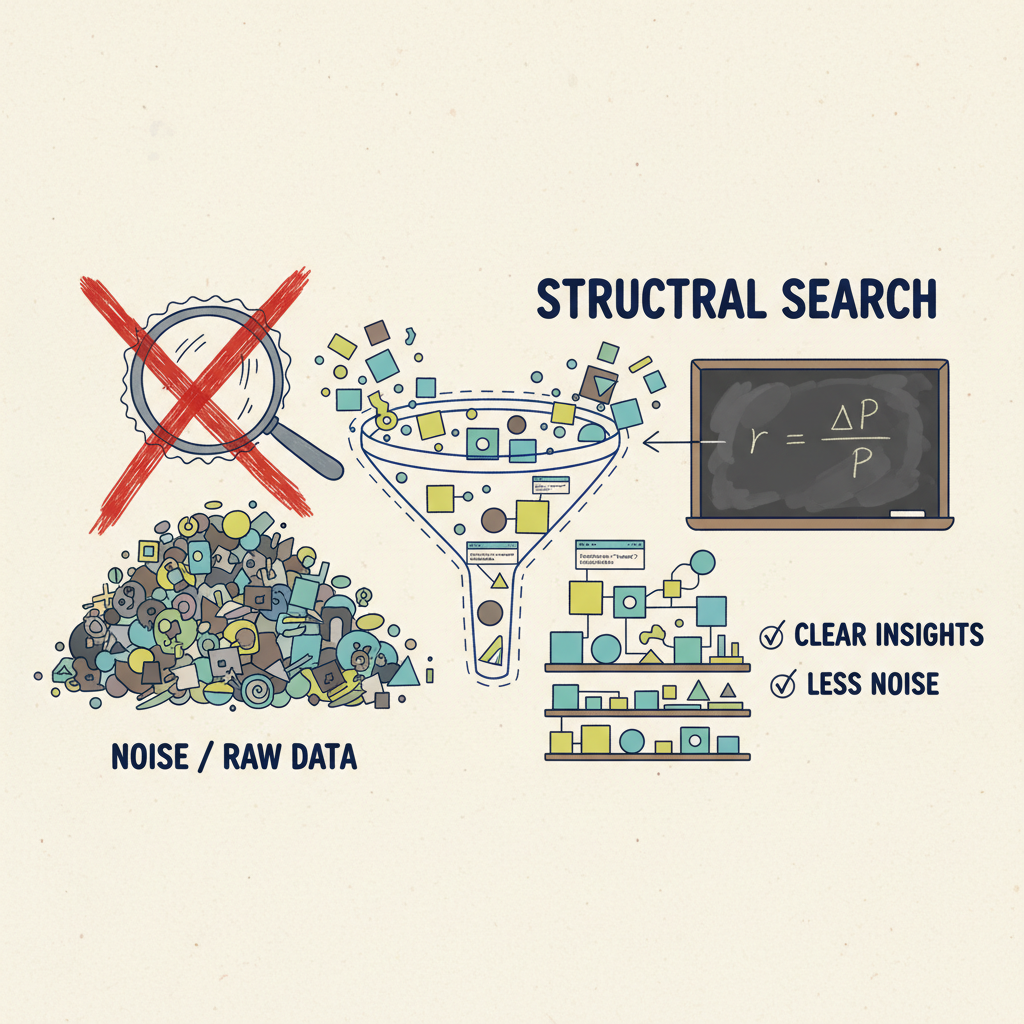
Structural search is not an indicator strategy. It is a way to decide where your attention should stay.
When the chart is noisy, most people do this:
- open many screens
- read many signals
- collect more “evidence”
- still feel uncertain
That happens because we confuse more data with better decisions.
Why this still matters
In trading, uncertainty disappears when constraints are clear. Not when information is endless.
1) Define the market scene first
Write one sentence before any chart hunting:
- Is the market in expansion or compression?
- Which level is currently controlling price?
- Is one side clearly pressing, or are both sides still fighting?
If you cannot write this in one sentence, everything that follows is reactive.
2) Separate structure from trigger
- Structure layer: What directions are allowed by higher-level context?
- Trigger layer: Which current-price condition permits execution?
This is a two-layer filter:
- structure decides validity
- trigger decides timing
Only when both layers align do you execute.
3) Treat lower timeframes as evidence, not authority
Lower timeframes are useful for urgency, but urgency alone is not proof. A strong local move is not enough if the structure is wrong.
Copy-ready workflow
Before action, write two lines:
- Current scene: “Price is compressing near X, move above Y invalidates this structure.”
- Trigger condition: “Execute only when trigger confirms the scene and risk is defined.”
If this takes longer than 20 seconds, you are still in collecting mode. That is the main source of noise fatigue.
Anti-noise rule
- Do not look for the best candle first.
- Confirm scene and constraints before urgency.
- Keep trigger narrow and explicit.
- If a trigger appears but scene broke first, re-check the scene.
When repeated, this changes the game: price can stay noisy, but your rule set stays stable.
Closing
Structural search is not about being right more often. It is about reducing wrong reads.
Keep this sentence:
Structure decides where your decision is allowed.
Trigger decides when you can execute.