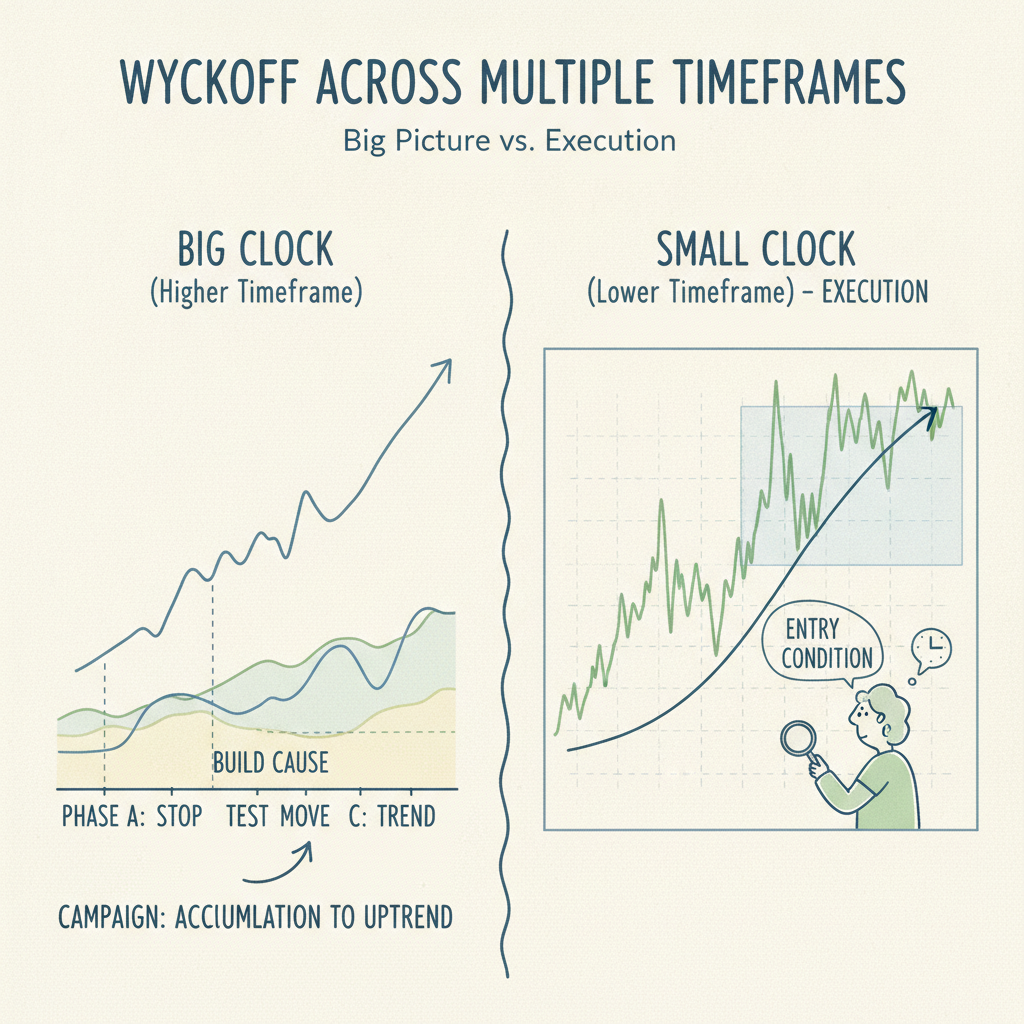
How Wyckoff actually uses multi-timeframe thinking: Phase up top, execution down below
A Wyckoff-style way to use MTF: fix the higher-timeframe phase/background first, then treat lower timeframes as execution conditions inside that scene.
If you learn Wyckoff as a set of patterns, multi-timeframe (MTF) quickly becomes messy. A 1‑hour chart looks like accumulation, but the 5‑minute chart dumps. Then the 5‑minute bounces hard and suddenly it feels like the higher-timeframe story flipped. The usual reaction is to open more timeframes, collect more reasons, and demand more certainty.
But Wyckoff’s intent is closer to “separate the roles of time” than “look at more.” Even if classic Wyckoff materials don’t use the modern term “MTF,” the method effectively assumes two clocks:
- The big clock: what phase the market is in, and what kind of campaign is underway
- The small clock: how price and activity respond inside that campaign The key is not to mix those clocks into the same question.
In Wyckoff, higher timeframes are for fixing the Phase and the Background
Wyckoff’s most important word isn’t “this candle looks good.” It’s background. Background is not built in a day or two. It emerges only on longer timeframes.
The higher-timeframe questions are usually like this:
- Are we inside a range, or transitioning into a trend?
- Does the situation resemble accumulation or distribution?
- Why is the range here—how does prior action (cause) load the present with weight (effect)? This level is not about timing. It’s about the scene. And once the scene is fixed, lower-timeframe noise is less likely to be misread as “the macro story changed,” and more likely to be read as waves inside the scene.
This resolves a common MTF misconception: The higher timeframe is not where you try to predict the next tick. It is where you decide what kind of move you are even allowed to expect.
Lower timeframes are not “proof,” but conditions for action inside the higher-timeframe scene
When you zoom in, you tend to look for proof: “If the higher timeframe is accumulation, the lower timeframe should stay strong.” Wyckoff logic is closer to the opposite.
If the higher timeframe defines the phase and the range, the lower timeframe is usually for:
- How price behaves at the edges of the range (absorption, rejection, shifting behavior)
- Whether a move is meaningful progress or mostly testing / expenditure
- What short, sharp wicks or bursts are doing in the context of the larger structure The crucial shift is this: lower-timeframe moves are not a declaration that the higher timeframe has flipped. They often function as parts of the higher-timeframe scene. The clearer the higher-timeframe context, the more the lower timeframe becomes record of “how” rather than a reason to rewrite “what.”
In a sentence, Wyckoff-style MTF is:
- Higher TF: Phase / Range / the weight of Cause→Effect
- Lower TF: the mechanism and conditions by which that weight shows up in price action That’s why it’s not “more charts,” but “separated questions.”
Modern web trading makes MTF harder because the lower timeframe is louder (fills, alerts, speed). Thinking starts at the trigger, and context gets attached afterward. Wyckoff pushes the opposite order: set the scene first, then let the lower timeframe matter only within that scene.
1k_scanner is not a document scanner—it’s a Rust + egui multi‑market, multi‑timeframe trading scanning app. Instead of increasing signals, it focuses on lowering observation friction so “higher‑timeframe scene → lower‑timeframe conditions” is easier to maintain.
Related content
When the trigger was right but the trade was wrong — what breaks when Bias → Context → Trigger flips
Before You Enter, Check 3 Things — Level / Bias / Trigger (with 1k_scanner)
Avoid Countertrend Traps with Multi-Timeframe Consensus — a 3-minute routine with 1k_scanner
A scanner that helps you decide where to look: what 1K Scanner actually is
Where Do You Trade: Structural Search
Why Wyckoff Phases Must Be Read on HTF: Historical Context and Practical Use
Why Wyckoff Phases Must Be Read on HTF: Historical Context and Practical Use
Wyckoff Phases gain meaning only inside the higher‑timeframe story. This post summarizes a practical, context‑first way to read them.
In practice, it’s easy to say “I see Phase A–E,” yet LTF readings are often distorted. Wyckoff Phases are not signals; they are structure, and structure becomes clear only inside the higher‑timeframe story.
Why HTF is mandatory
- Phases are structure, not signals. Structure is defined over longer accumulation and distribution ranges.
- The same event can mean different things. A spring or UT in LTF changes its meaning under HTF context.
- Historical context separates intent. Accumulation vs. redistribution is a HTF decision.
Common distortions in real trading
- A spring on LTF triggers an entry → HTF shows it’s still Phase B noise
- “Final markdown” on LTF → HTF reveals a normal pullback in Phase D
- A small range looks like accumulation → HTF shows it’s just a lower‑range test
HTF checklist (copy & paste)
- Does the range include at least 2–3 major swings?
- Is the accumulation/distribution story clear on HTF?
- Do key events align with HTF boundaries?
- Does any LTF event violate the HTF rule set?
Bias → Context → Trigger framework
- Bias: Decide the HTF directional tilt first.
- Context: Locate which Phase (A–E) you are in and what the tests imply.
- Trigger: Use LTF signals last. Signals confirm, they do not decide.
Summary
Wyckoff is not about spotting events on lower timeframes. It is about interpreting a higher‑timeframe story, then filtering LTF noise.
To read this properly you need multi‑exchange, multi‑timeframe alignment. 1K Scanner scans HTF structure and LTF triggers together, so Phase interpretation becomes a usable decision flow.