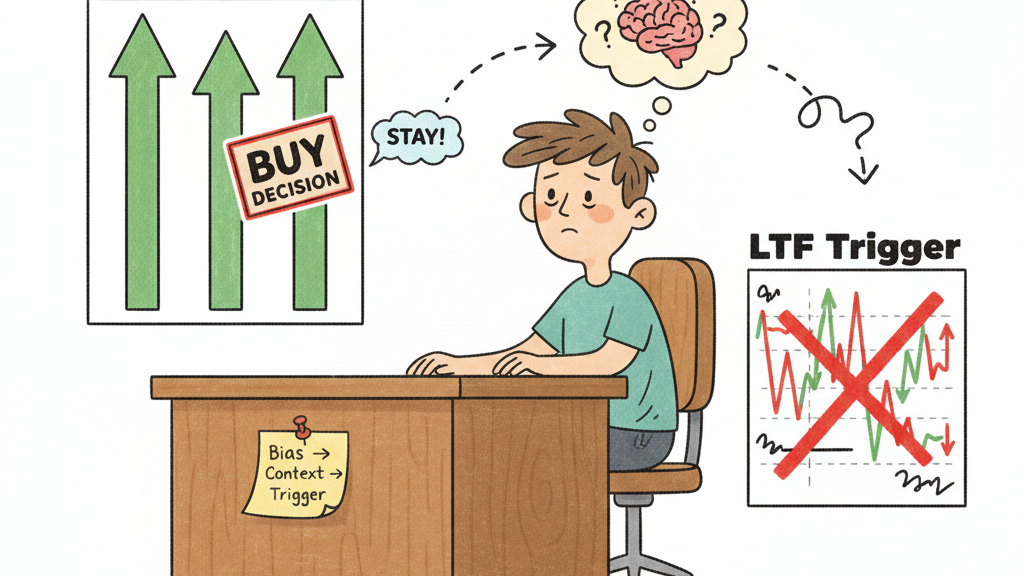
FOMO in trading feels sudden, but in practice it appears more often when we are underprepared. When price moves fast and your hand reacts first, the real issue is often not missing strategy knowledge. It is that your candidate list was empty before the move began.
This post is not motivational advice. It is a practical candidate prebuild routine that helps reduce FOMO in real sessions.
1) FOMO spikes in predictable moments
Emotional entries become more likely when these conditions overlap:
- you chase a symbol that just exploded instead of one you tracked
- you decide from lower-timeframe candles without higher-timeframe context
- “I might miss it” replaces “what is my rule here?”
The key idea is simple: if candidates are not prepared, market speed becomes your decision framework.
2) Start with candidate design, not entry complexity
A reliable way to reduce FOMO is not adding more entry indicators. First, predefine what deserves attention today.
Use this 3-step frame:
- Bias: your directional/regime hypothesis for today
- Context: hold/break/reclaim conditions on higher timeframes
- Trigger: minimum lower-timeframe condition that allows execution
With this order, a sudden breakout no longer means auto-chase. You first ask: “is this one of my candidates?”
3) Four fields every candidate should include
Long candidate lists do not help. Short, reusable candidate cards work better.
For each candidate, record these four fields:
- Assumption: why this structure is relevant now
- Constraint: condition that immediately disqualifies the setup
- Trigger: minimum executable signal
- Expiry time: when this candidate is no longer valid
This flips your behavior in fast markets. Instead of searching for reasons to enter, you can quickly see reasons to pause.
4) Three questions before every entry
Right before execution, run these three checks:
- Is this inside today’s prebuilt candidate list?
- Did this move happen inside my Context conditions?
- Is Trigger confirmed, or am I reacting to candle speed?
If even one answer is “no,” observation is usually better than execution.
5) Reduce post-miss regret with two operating rules
FOMO is not only an entry problem. It repeats through poor review habits after missed moves.
Keep these two rules fixed:
- log missed trades as “candidate rule review,” not “lost opportunity”
- before P/L, note which element you skipped: assumption, constraint, or trigger
Over time, this improves decision consistency before it improves outcomes.
6) Copy-paste checklist for session open
Use these six lines at the start of every session:
- write one-line Bias
- keep only 3 to 7 candidates
- define assumption/constraint/trigger for each candidate
- set expiry time
- rerun the 3 entry questions before every execution
- log one skipped condition at session close
You cannot eliminate FOMO completely. But with prebuilt candidates, emotion shifts from an execution command to a warning signal.
If you use 1k_scanner, compress candidates from the full market first, then execute only when your final conditions remain valid.