How to Treat Early Altcoin Breakouts as Candidates, Not Predictions
A practical framework for managing early altcoin breakout setups as candidates instead of forcing predictions.
There are many moments when altcoins look like they are about to explode. The problem is that once you lock that moment in as a prediction, it becomes much harder to step away when the setup starts to fail.
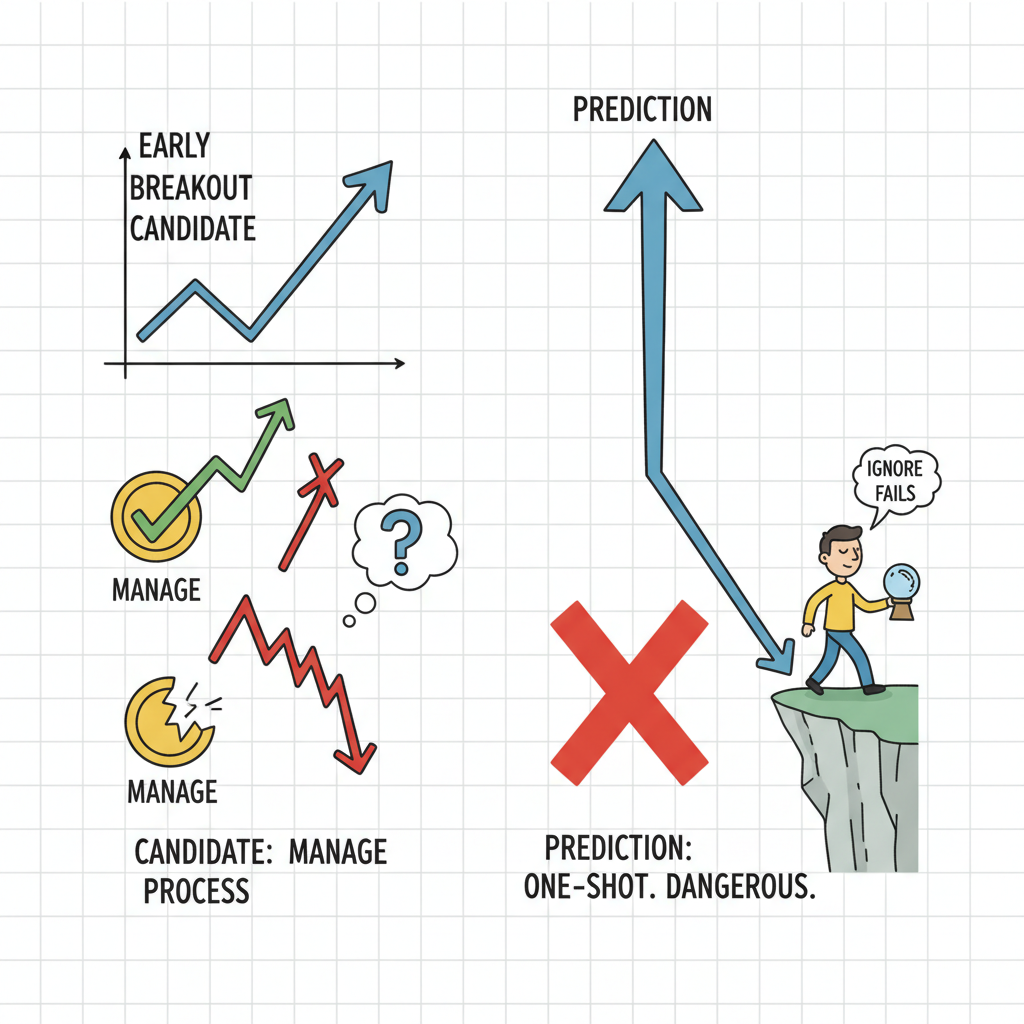
The conclusion of this post is simple. If you approach those moments as candidate management instead of prediction, the early breakout phase stops being a game of “calling the move” and becomes a process you can actually manage.
Why prediction is dangerous
Prediction is a one-shot structure. You commit to a single judgment, and once the setup looks good for even a moment, it becomes easy to ignore everything that happens after that.
That usually creates two problems.
- You keep holding even while invalidation signals are already visible.
- When the idea is wrong, you still expect the next candle to prove you right. So the real danger is not the missed prediction. It is the damage that builds when the prediction fails.
What candidate framing changes
Candidate framing is not about declaring a winner. It is about building a manageable list.
The core is simple.
- Write the conditions first.
- If those conditions are met, move it to a candidate list only.
- Keep a clear invalidation rule beside it. That way, the list can grow without letting the damage grow with it. You are no longer trying to be right. You are trying to manage attention and risk.
Conditions first: higher-timeframe structure has to align
Early altcoin breakouts are not explained by lower timeframes alone. If higher-timeframe structure is not aligned, even a sharp lower-timeframe move can fail quickly.
That is why the first check should be structural.
- Has the higher timeframe reclaimed or confirmed the upper part of the range?
- Is the structural low still intact?
- Is the lower-timeframe push aligned with the higher-timeframe direction? If these are not in place, the lower-timeframe move is often just noise with better marketing.
Invalidation matters: candidates must come off the list quickly
The most important part of candidate framing is clear invalidation. If one of the following happens, the candidate should come off the list immediately.
- The higher-timeframe structural low breaks
- A retest fails and lower-timeframe structure turns down
- The move pushes higher without real volume behind it Without sharp invalidation, candidate framing becomes nothing more than prediction with softer language.
A simple checklist you can reuse
Here is a minimum checklist for this workflow.
- Is the higher-timeframe structure clear?
- Is the lower-timeframe move aligned with the higher-timeframe direction?
- Are the conditions written down in plain language?
- Can the invalidation rule be explained in one sentence?
- Is the candidate list limited to roughly 3 to 7 names? Even this small structure makes the process far more stable than prediction-first trading.
Summary
Trying to predict the exact start of an altcoin breakout usually creates unnecessary damage. A better framework is candidate -> invalidation. That turns the early breakout phase into something you can monitor instead of something you need to guess.
1K Scanner is built for this kind of workflow. It helps you keep multi-timeframe structure and candidate scanning visible in one place, so you can manage potential breakouts instead of chasing certainty.
The edge is not in calling the move first. It is in keeping the right candidates in front of you while the weak ones fall off the list.